
Pharmaceutical Solutions

Water of absolute purity is required to produce medicines and as a raw material in chemical products. Strict purity regulations must be met by every manufacturer operating in this industry and failure to comply can result in product recalls, regulatory action, and serious patient safety risk.

Thwalokuhle designs and builds, installs, and manages complete pharmaceutical water treatment systems helping manufacturers of medical products reach higher levels of operational efficiency at reduced lifecycle cost. Our systems are engineered, documented, and validated to meet every applicable global standard, from the initial design phase through to ongoing operational performance.

02 STANDARDS

REGULATORY STANDARDS

Standard 01

cGMP Requirements

Current Good Manufacturing Practice regulations govern the design, construction, and operation of pharmaceutical water systems. Our systems are built to cGMP principles — including material traceability, hygienic design, and change control documentation.

Standard 02

GAMP Validation Control System

Good Automated Manufacturing Practice (GAMP 5) provides the framework for computerised system validation in pharmaceutical environments. Our automation and control systems are designed and documented to GAMP category requirements, ensuring your control system is audit-ready.

Standard 03

ISPE Engineering Guide

The International Society for Pharmaceutical Engineering (ISPE) Baseline Guide for Water and Steam Systems defines best-practice engineering for pharmaceutical water. Our team designs to ISPE guidance as the technical baseline for system architecture, materials, and hygienic design.

Standard 04

USP & BP Pharmacopoeia Standards

Purified Water, Highly Purified Water, and Water for Injection are defined — with specific chemical, microbial, and endotoxin limits — in both the United States Pharmacopeia (USP) and British Pharmacopoeia (BP). Our systems are designed and validated to meet the latest monograph specifications for each water grade.

3. Services

Purified Water (PW) is used across a broad range of pharmaceutical manufacturing processes — from the preparation of non-sterile medicines and oral dosage forms, to equipment cleaning and general process applications. Our PW systems are designed using RO membrane technology, with appropriate pre-treatment and distribution, producing water that consistently meets USP, BP, and EP specifications.

Highly Purified Water (HPW) is required for preparations where a very high biological quality is needed but the use of Water for Injection is not mandated. HPW meets the chemical and endotoxin purity specifications of WFI while being produced using advanced membrane and purification technology rather than distillation. It is the preferred choice for ophthalmic preparations, haemodialysis, and other critical applications.

Water for Injection (WFI) is the highest pharmaceutical water grade — used in the manufacture of parenteral (injectable) preparations, for the final rinse of sterile product-contact equipment, and in all critical sterile manufacturing processes. Thwalokuhle produces WFI using steam distillation technology, which meets the requirements of the European Pharmacopoeia (EP), USP, and BP. WFI is stored and distributed in heated, circulating stainless steel loop systems to prevent microbial growth.

Pure Steam is used for the sterilisation of product-contact surfaces, equipment, stoppers, filters, and filling lines in aseptic pharmaceutical manufacturing. Unlike plant steam, Pure Steam is generated from Purified Water and contains no boiler additives or other chemical contaminants — meaning its condensate meets WFI quality specifications. Our Pure Steam Generators (PSG) are designed for integration into your existing steam sterilisation and SIP (sterilise-in-place) workflows.

04 OUR TECH

Technology

01 / 06
RO Single Pass

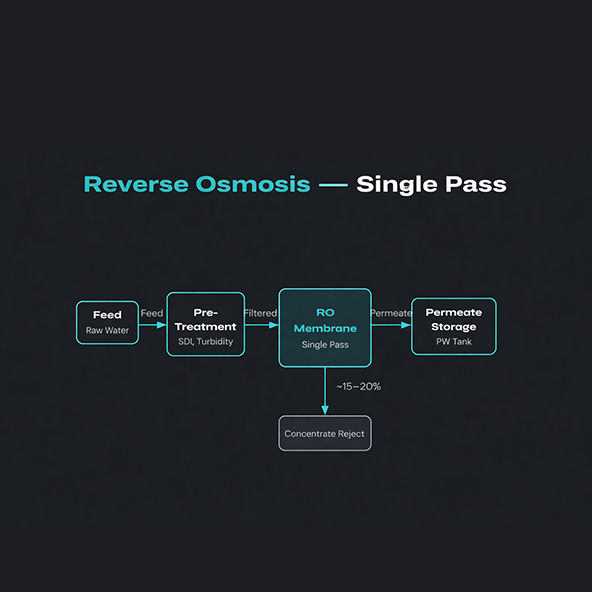
Reverse Osmosis Single Pass

Single-pass Reverse Osmosis (RO) uses a semi-permeable membrane under pressure to remove up to 98% of dissolved salts, organics, microorganisms, pyrogens, and particulates from the feed water. The process produces a permeate (purified water) and a concentrate stream (reject) that is discharged or recirculated.

Single-pass RO is the primary technology used to produce Purified Water (PW) for pharmaceutical applications. It is typically preceded by pre-treatment (multimedia filtration, carbon filtration, softening, and microfiltration) to protect the membrane and ensure consistent permeate quality.

.
02 / 06
RO Double Pass

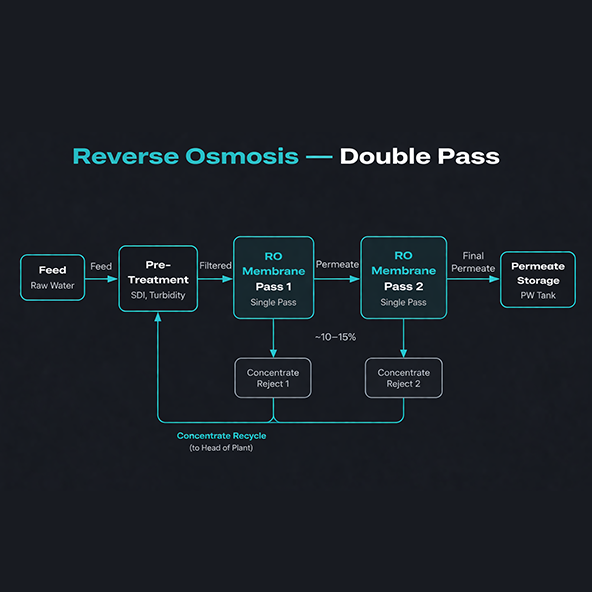
Reverse Osmosis Double Pass

Double-pass RO passes the permeate from the first RO stage through a second RO stage, achieving significantly higher purity than single-pass alone. The second pass removes residual dissolved ions, CO₂, and organics that break through the first membrane stage — achieving conductivities well below 0.1 µS/cm.

Double-pass RO is commonly used as the primary purification step in Highly Purified Water (HPW) systems, and as the pre-treatment stage before EDI in high-purity applications. The reject from the second pass is typically recycled back to the first-pass feed to maximise water recovery.

03 / 06
RO + EDI

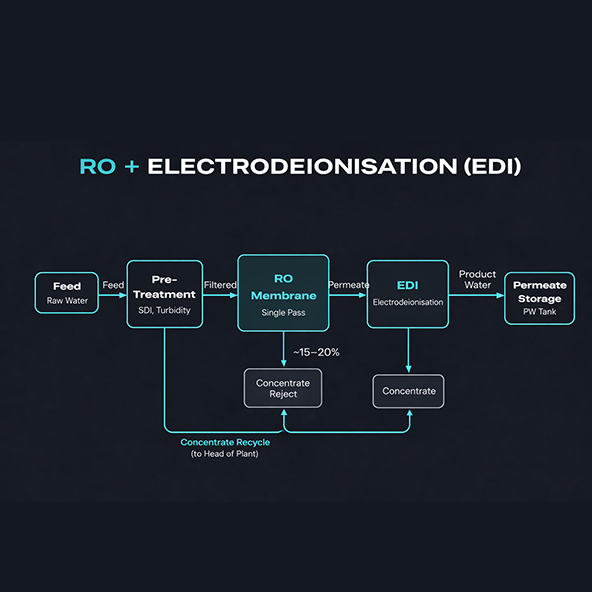
RO + Electrodeionisation (EDI)

Electrodeionisation (EDI) combines ion-exchange resin with ion-selective membranes and a direct electrical current to continuously remove dissolved ions from RO permeate — without the need for chemical regeneration. This makes it the cleanest and most operationally simple polishing technology available.

In pharmaceutical applications, RO + EDI is the dominant technology for producing Purified Water and Highly Purified Water. EDI replaces traditional mixed-bed ion exchange, eliminating the chemical waste streams associated with resin regeneration and making the system easier to validate and operate to cGMP requirements.

04 / 06
WFI — Steam Distillation

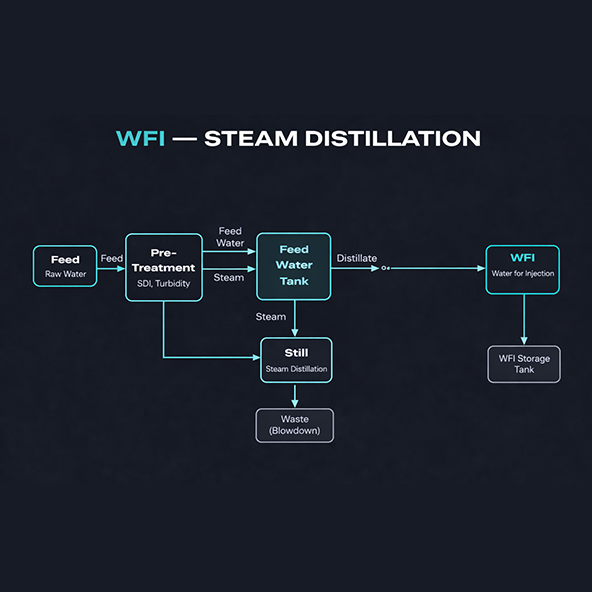
WFI — Steam Distillation

Water for Injection (WFI) produced by steam distillation is essential in South Africa’s pharmaceutical and biotechnology industries, where ultra-pure water is required for sterile processes. The system heats purified water to generate steam, which is then condensed into WFI, effectively removing contaminants such as microorganisms, endotoxins, and dissolved solids. This ensures compliance with South African Health Products Regulatory Authority (SAHPRA) as well as international standards like USP and the European Pharmacopoeia.

Steam distillation is widely used due to its reliability and built-in thermal sanitization, reducing microbial risks in line with GMP requirements. Technologies like multiple-effect distillation (MED) and vapor compression improve efficiency while maintaining consistent water quality. Automated systems further support stable and compliant WFI production.

05 / 06
Pure Steam Generator

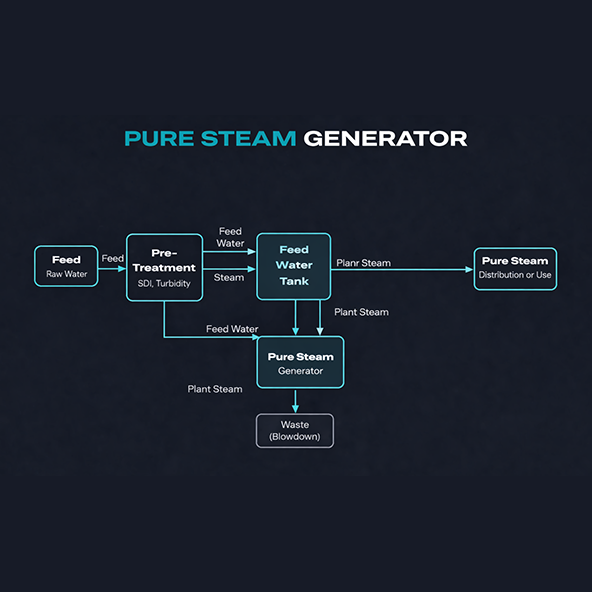
Pure Steam Generator

A Pure Steam Generator (PSG) produces pharmaceutical-grade steam for sterilisation and clean steam applications in aseptic manufacturing. Unlike plant steam — which contains boiler treatment chemicals, rust particles, and other contaminants — Pure Steam is generated from Purified Water, using plant steam as the heating medium in a shell-and-tube heat exchanger.

Pure Steam condensate meets Water for Injection (WFI) quality specifications, making it safe for direct contact with product-contact surfaces, injectable product, and sterile equipment. Our PSGs are designed and constructed to ISPE and ASME BPE standards, with fully drainable, sloped, sanitary surfaces throughout.

06 / 06
Hot & Cold Loop Distribution

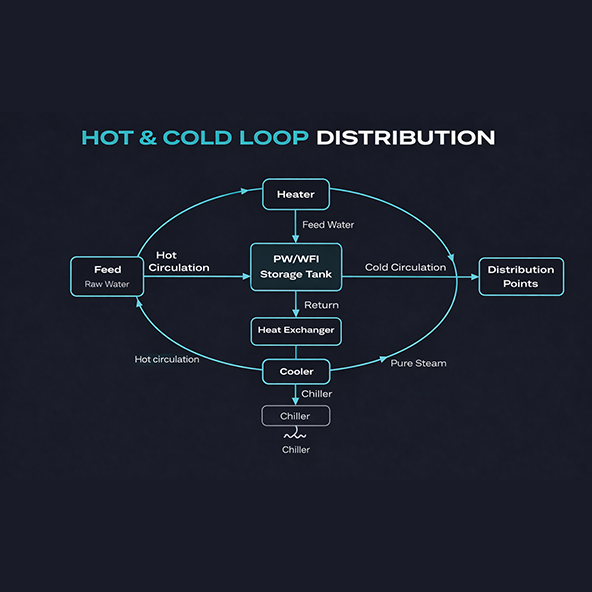
Hot & Cold Loop Distribution

Once produced, pharmaceutical water must be stored and distributed to point-of-use in a way that prevents microbial growth, chemical contamination, and biofilm formation. A continuously circulating distribution loop — maintained at a controlled temperature — is the only acceptable approach for WFI and PW distribution in a cGMP facility.

Thwalokuhle designs and installs both hot loop systems (WFI maintained at ≥ 80°C to prevent microbial proliferation) and cold loop systems (PW maintained at ≤ 25°C with appropriate sanitisation cycles). All loops are sloped to drain, constructed in electropolished 316L stainless steel, and fitted with orbital-welded hygienic fittings throughout.

5. Maintenance

Comprehensive monthly walkdown of all system components — including pre-treatment trains, membranes, tanks, pipework, instruments, and distribution loops. Findings are documented in a site inspection report aligned to your change control and quality management requirements.

Scheduled replacement and supply of all consumable filter cartridges — including pre-filtration, microfiltration, and polishing cartridges — to manufacturer specifications and validated change frequencies. All cartridges supplied with full traceability and certificate of conformance documentation.

Clean-In-Place (CIP) servicing of pre-treatment and RO water treatment equipment, including chemical cleaning of RO membranes, sanitisation of multimedia filter vessels, and flushing of activated carbon beds. All procedures conducted to validated CIP protocols and Good Manufacturing Practice requirements.

Scheduled Clean-In-Place cycles for purified water storage tanks, WFI storage vessels, and chemical preparation tanks. Includes full drain, rinse, chemical wash, and final rinse verification — with pre- and post-CIP water quality sampling to confirm microbial and chemical acceptance criteria.

Preventive maintenance and service of all system pumps — including RO high-pressure feed pumps, distribution loop pumps, booster pumps, and CIP pumps. Seal inspection and replacement, bearing checks, impeller inspection, performance curve verification, and mechanical integrity testing are carried out to OEM schedules.

Accredited calibration of all process monitoring and control instruments — covering pH sensors, conductivity transmitters, temperature sensors, and pressure indicators. Calibration is performed against NIST-traceable standards, with calibration certificates issued for each instrument and records retained for regulatory audit.

Scheduled servicing of all ultraviolet disinfection units in the water treatment and distribution system. Includes UV lamp replacement at validated intervals, quartz sleeve cleaning and inspection, intensity sensor verification, and lamp-hours log review — maintaining effective microbial reduction performance and cGMP compliance at all times.

Our Clients

quick contact:
follow us: